A yoga pose is called an asana in Sanskrit. Twelve basic poses are enough for a beginner: mountain, cat-cow, child's pose, downward-facing dog, cobra, warrior I and II, triangle, tree, bridge, seated forward bend and the relaxation pose. You will meet them in almost every hatha yoga class.
What is an asana?
An asana is a yoga pose – a position of the body that you hold for several breaths. The word comes from Sanskrit and means “seat” or “posture”. That is why the names of many poses end in “-asana”: tadasana, balasana, shavasana.
Yoga poses are not only stretching. Some build strength, some train balance, and others teach you to relax. In all of them, calm breathing through the nose matters most.
Yoga pose names: a table
| No. | English name | Sanskrit name | What it trains |
|---|---|---|---|
| 1 | Mountain pose | Tadasana | Posture, balance |
| 2 | Cat-cow pose | Marjaryasana–Bitilasana | Mobility of the spine |
| 3 | Child's pose | Balasana | Rest, the lower back |
| 4 | Downward-facing dog | Adho Mukha Svanasana | Shoulders, back, backs of the legs |
| 5 | Cobra pose | Bhujangasana | Back muscles, opening the chest |
| 6 | Warrior I | Virabhadrasana I | Leg strength, hips |
| 7 | Warrior II | Virabhadrasana II | Leg strength, stability |
| 8 | Triangle pose | Trikonasana | Sides of the body, legs |
| 9 | Tree pose | Vrikshasana | Balance, focus |
| 10 | Bridge pose | Setu Bandhasana | Glutes, back |
| 11 | Seated forward bend | Paschimottanasana | The back of the body |
| 12 | Relaxation pose | Shavasana | Relaxation |
How to do the 12 basic yoga poses
1. Mountain pose (Tadasana)
Stand with your feet hip-width apart and your weight even on both feet. Lengthen the spine, lower the shoulders and let the arms hang by your sides. Stay for 5 breaths. It looks simple, but it is the foundation of all standing poses.
2. Cat-cow pose (Marjaryasana–Bitilasana)
Come onto all fours: hands under shoulders, knees under hips. As you breathe in, let the back dip and lift the chest. As you breathe out, round the back upwards and lower the head. Repeat 5–10 times.
Easier: put a folded blanket under your knees.
3. Child's pose (Balasana)
From all fours, sit back on your heels and lower your forehead to the mat. Stretch your arms forwards or rest them alongside the body. This is a resting pose – you can come back to it at any point in a class.
Easier: if your hips do not reach your heels, put a cushion between them.
4. Downward-facing dog (Adho Mukha Svanasana)
From all fours, lift the hips up – the body looks like an upside-down letter V. Hands shoulder-width apart, fingers spread, head relaxed between the arms.
Easier: bend your knees. A long back matters more than straight legs.
5. Cobra pose (Bhujangasana)
Lie on your front with your hands under your shoulders. As you breathe in, lift the chest; the elbows stay slightly bent and close to your sides, and the shoulders stay away from the ears.
Easier: lift only a little, or rest on your forearms (sphinx pose).
6. Warrior I (Virabhadrasana I)
Take a long step back. Bend the front knee so that it is above the ankle, and turn the back foot out to about 45 degrees. Turn the hips forwards and raise the arms.
Easier: shorten the step and keep your hands on your hips.
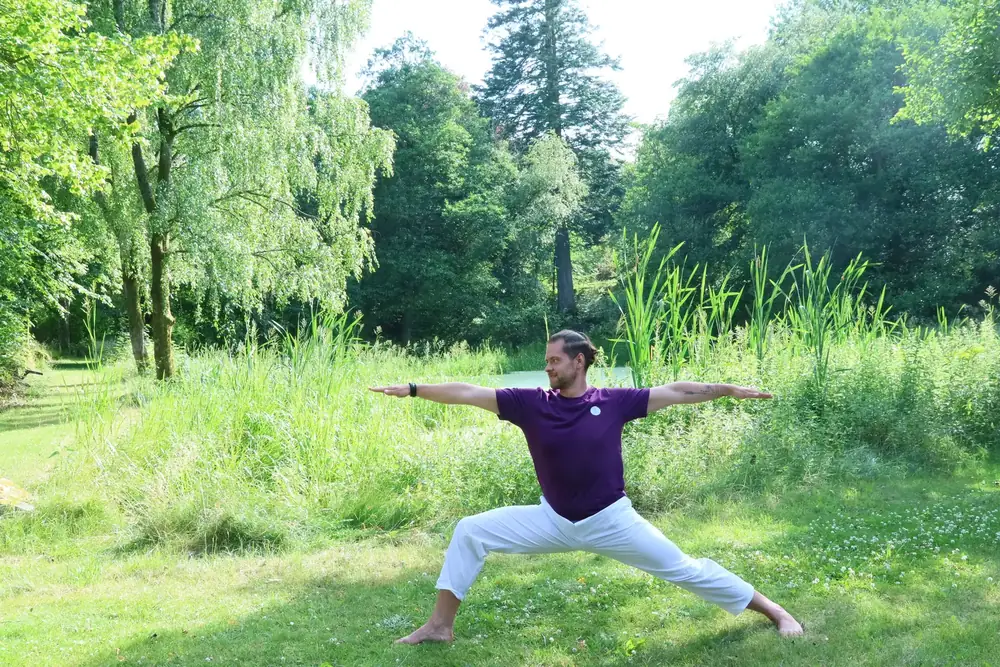
7. Warrior II (Virabhadrasana II)
Feet wide apart. The front foot points forwards, the back foot is turned across the mat. Bend the front knee above the ankle, stretch the arms out to the sides at shoulder height and look over the front hand.
Easier: bend the knee less.
8. Triangle pose (Trikonasana)
Feet wide apart, legs straight. Lean sideways over the front leg. Rest the lower hand on the shin (not on the knee) and raise the upper arm.
Easier: place the lower hand higher on the shin or on a thick book.
9. Tree pose (Vrikshasana)
Standing, shift your weight onto one leg. Rest the sole of the other foot against the calf or the thigh, but not against the knee. Bring the palms together at the chest and keep your gaze on one point.
Easier: leave the toes on the floor or hold on to a wall.
10. Bridge pose (Setu Bandhasana)
Lie on your back, bend your knees and place your feet hip-width apart, close to the hips. As you breathe in, lift the hips. The shoulders and head stay on the mat; do not turn the head to the sides.
Easier: lift the hips only as far as is comfortable.
11. Seated forward bend (Paschimottanasana)
Sit with your legs stretched out. As you breathe in, lengthen the spine; as you breathe out, fold forwards from the hips rather than rounding the back.
Easier: bend your knees or sit on a folded blanket.
12. Relaxation pose (Shavasana)
Lie on your back, let the arms and legs rest loosely and close your eyes. Stay for 3–5 minutes. Literally the name means “corpse pose”. Every class ends with it.
A 15-minute sequence for beginners
You can put these poses together into a short practice at home. Stay in each pose for 5 calm breaths.
- Mountain pose – 1 min.
- Cat-cow pose – 10 times.
- Downward-facing dog.
- Child's pose.
- Warrior II – both sides.
- Triangle pose – both sides.
- Tree pose – on both legs.
- Cobra pose – 3 times.
- Bridge pose – 3 times.
- Seated forward bend.
- Relaxation pose – 3 min.
If you only have a minute – a short morning flow with downward-facing dog:
How to practise safely
- Breathe calmly through the nose. If your breath becomes uneven, the pose is too deep.
- Tell stretch from pain. A feeling of stretch is normal; sharp pain is a sign to stop.
- Do not lock your knees and elbows. Keep them very slightly bent.
- Do not rush. Move into and out of a pose slowly.
If you have injuries or high blood pressure, or are pregnant, talk to your doctor before practising.
It is hard to tell from a description whether you are doing a pose correctly. That is why it is worth learning at the start with a teacher who sees you. More in “Yoga for beginners: where to start”.
Frequently asked questions about yoga poses
A yoga pose is called an asana. It is a Sanskrit word meaning “seat” or “posture”.
For beginners, 5 calm breaths are enough – about 30 seconds. In hatha yoga poses are held longer than in dynamic vinyasa yoga.
Mountain pose, child's pose and the relaxation pose. They are a good place to start.
It is a sequence of poses (Surya Namaskar) in which the poses flow smoothly into one another with the breath. It is often done at the start of a class to warm up the body.
Yes, if the practice is short and gentle. 10–15 minutes a day is a good addition to one or two classes a week.
Want someone to correct your poses? In the hatha yoga classes for beginners we learn these poses live on Google Meet, in groups of up to 8. A class costs €12. If you are not sure, book a free 20-minute call.